
The Scaling Engine
Everything we teach,
we did first.
Built by an operator, not a consultant. 735 restaurants, $200M+ a year, and a $509M valuation.
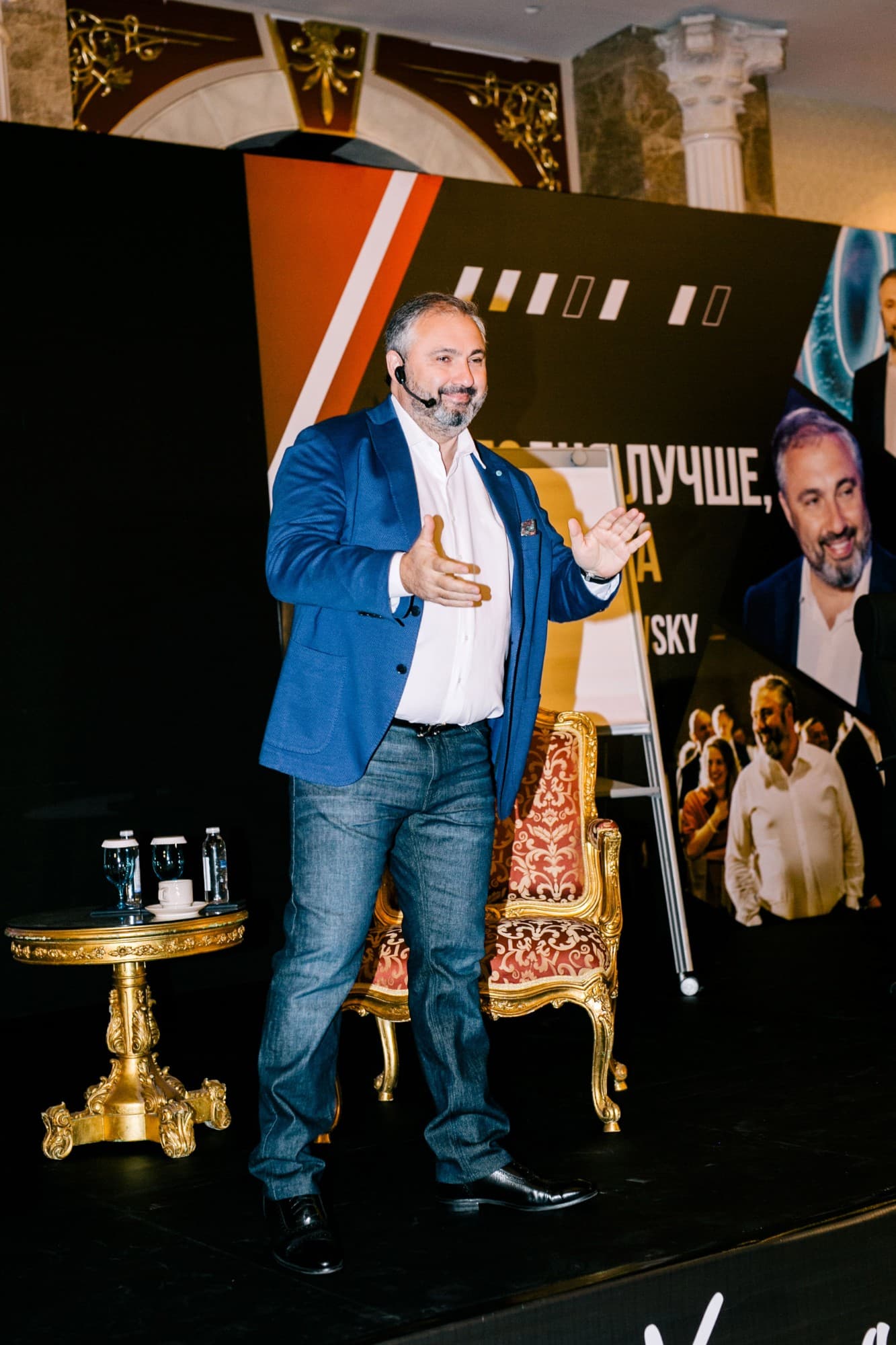
Watch Alex break down how he built 735 locations.
Fifty five minutes, from making pizza for $4 an hour to 735 locations in six years.
Meet the people behind the system

Alex Yanovsky
Founder and Head Coach
Alex was going to be a trombone player. He ended up building 735 restaurants.
He has started companies in three countries across four decades and has never once run the day to day of any of them. That is not laziness. It is the whole method, and it is what this site teaches.
He built Sushi Master with a student of his, twelve locations to 735 in six years. At its peak: $200M+ a year, 10,000 people, a $509M valuation.
He started teaching in 2010, and only because the managers he had trained kept coming back to ask him how he had done it.
He built this one with his son.

Elan Yanovsky
Co-Founder and Growth Strategist
Elan is Alex's son. He has been at the back of these rooms since he was fifteen.
Seven years of sitting through his father's events, and what stayed with him was never the material. It was the owners who found him afterwards to tell him what that teaching had done to their business.
He did not only watch it. He opened restaurants for Sushi Master and ran a region of seven locations while the group was scaling, which is the same work the Accelerator asks of an owner.
He co-founded The Scaling Engine with Alex so the rest of it would exist in English, and he runs its growth.
The man who built 735 restaurants has never worked a shift in one.
Alex Yanovsky was going to spend his life in an orchestra. He was one of the better young trombone players in the Soviet Union, trained at what he still calls the Harvard of music there.
His father taught music. His mother was an engineer. Nobody in that house had ever run a company, and nobody expected him to.
Then he left. He was twenty, and he was broke.
He calls the day he landed in New York the happiest of his life, and not because anything got easier. Because it was the first day nobody could tell him what to do.
Hold onto that, because it is the same thing you wanted the day you opened. And it is the thing you have least of now.
Then he made pizza. Four dollars an hour. For a year.
After that, waiting tables in California. Then a law office, where he started as the secretary and was running the place eight months later.
Eight months was all he needed. At twenty four he walked out and opened the same kind of business himself, knowing, in his words, eighty percent of how it worked.
He built a $30 million company. Then he found out he could not sell it.
It worked. That is the part people skip over.
By twenty nine he had two hundred employees and thirty million dollars a year, in a business he had started five years earlier.
He ran it for ten years. Then he closed it.
Not because it failed. Because when he was finally done with it, there was nobody to sell it to.
Thirty million a year, two hundred people, a decade of his life, and on the day he wanted out it was worth nothing to anyone else.
That is what an owner run business is worth the day the owner stops. Not what it turns over. What it can do without him.
Build the business, not the job.
What he did next sounds like a character flaw. Read it twice.
“I hated doing anything with my own hands. So I was building the structure, teaching the people and reading the numbers, and other people did the work.”
The thing that sounds like a flaw is the method. He never ran the day to day of a single company he owned. Not once. Not when it was small, not when it was in trouble, not when doing it himself would have been faster.
His job was the layer underneath. The standards. The numbers his managers read every week. The decisions each of them could make without calling him, and a name against every one of those.
He calls himself an inventor of management rather than of products. A composer, in his words.
What he wrote down over those four decades has a name now. The Seven Step Management System. It is the thing this company installs, and it is the only thing it installs.
Then he proved it twice.
Ukraine, at thirty five. Fifty five supermarkets. Seven months from the idea to opening the first one. Five months for the other fifty four. Over a thousand employees inside a single year.
That one he sold.
In 2016 a student of his owned twelve sushi restaurants and wanted to know how to scale them. Alex offered to partner rather than teach.
Six years later there were 735 of them.
The systems on this site were not invented for a course. They are what he ran three companies with, across four decades and three countries, written down afterwards.
You are not the problem. The way it is built is.
You did not get here by accident.
You opened. You made it work when most do not. You covered the shifts nobody else would, fixed what broke at eleven at night, hired, fired, and learned all of it standing on the floor.
Then somewhere around the second location, or the third, it stopped working the way it used to.
Not suddenly. Slowly. The kind of slow you can explain away for years.
The phone still goes on your day off. Every real decision still finds its way back to you. You are working more hours than you did when the business was half the size.
And a restaurant that runs without you has quietly stopped being a plan and turned into a story you tell yourself.
You are not lazy and you are not a bad operator. You are the best employee in your own company, which is a different problem entirely.
The business was organised around one person. That person is you.
He found that out at thirty four, with two hundred people and nothing to sell. It cost him ten years.
It does not have to cost you the same.
This is not a course. It is not a mastermind. It is not a consultant with a deck.
If you have bought a course, you got information. What you did not get was anyone inside your building making sure it happened.
If you have joined a mastermind, you got a room of people and some good ideas. What you did not get was execution.
If you have hired a consultant, you got a report and a plan. What you did not get was a team that could run it after they left.
We are solving a different problem. Most programmes are trying to make you a better operator.
We are trying to build a restaurant that does not need you standing in it.
So we install the system: the standards, the numbers your managers read every week, the decisions they are allowed to make without calling you, and the meeting rhythm that keeps all of it running. Then we coach you through stepping back, which is the part nobody tells you is the hard bit.
It is not about working less hours. It is about building something that works while you are not there. Those are different things.
What it looks like when it is in.
Picture an ordinary week, six months from now.
Monday. Last week’s numbers are on your phone before you have asked for them, because your managers read them every Monday and that is simply what happens now.
Wednesday. A supplier moves a price. Your kitchen manager handles it and tells you afterwards, because she knows exactly which decisions are hers.
Friday night. Something breaks. You hear about it on Saturday, in a message that starts with what was already done about it.
You did not get better at running the restaurant. You stopped having to.
That is the whole difference, and it is the only thing worth six months of your attention.
It took him thirty years. With the right teacher it takes one.
His analogy is a door.
You are standing in front of it. It is locked, you do not have the key, so you file one yourself. You try it. It does not turn. You go back and file another.
“You make a key, it doesn’t work. Then another one. It doesn’t work.”
He filed keys for thirty years. Three companies, three countries, and the first one closed because he had not cut the right one yet.
That is all this is. The key, already cut, and somebody standing next to you while you turn it.
You can keep filing. Plenty of owners do. Some of them are still filing at sixty, in a business nobody will buy.
Or you can take six months.
We work with a specific kind of owner
Not everyone is a fit, and that is on purpose.
The owners we work with are usually doing $500K to $50M. They have a team. They have proven the concept, often several times over. They are not stuck because they lack drive or ability. They are stuck because the business is still organised around them.
They have usually tried things already. A new GM. A consultant. A POS that promised dashboards. Some of it helped. None of it moved the thing they actually wanted moved.
They are wary of big promises and they want to see the mechanism, not the outcome. If that is you, good. That is exactly who this was written for.
What we believe
- 01The point of building a restaurant is not to own a job you cannot leave.
- 02Systems create freedom. It does not work the other way around.
- 03Most owners are not the problem. The way their business is organised is.
- 04A manager with a title and no method is still waiting for you to decide.
- 05The best thing you can do for your team and your family is build something that does not need you there every day.
We are not here to motivate you and we are not here to hold you accountable. We are here to install the thing that makes the rest of it work.
Want to know whether there is a fit?
We work with a small number of companies at a time. The application takes about five minutes and tells us whether we can actually help. If we can, we will come back with a clear next step. If we cannot, we will tell you that too.
Results vary and are not typical. Outcomes depend on each owner's business, market, team and effort. We provide education and coaching, not guaranteed revenue, profit or growth.