
Most restaurant owners manage staff by instinct. They know who is good and who is struggling, but they rarely have a system that tracks it over time or tells them when to act. A talent development system fixes that by turning performance into data that can be reviewed, compared, and improved.
What is a talent development system for restaurant staff?
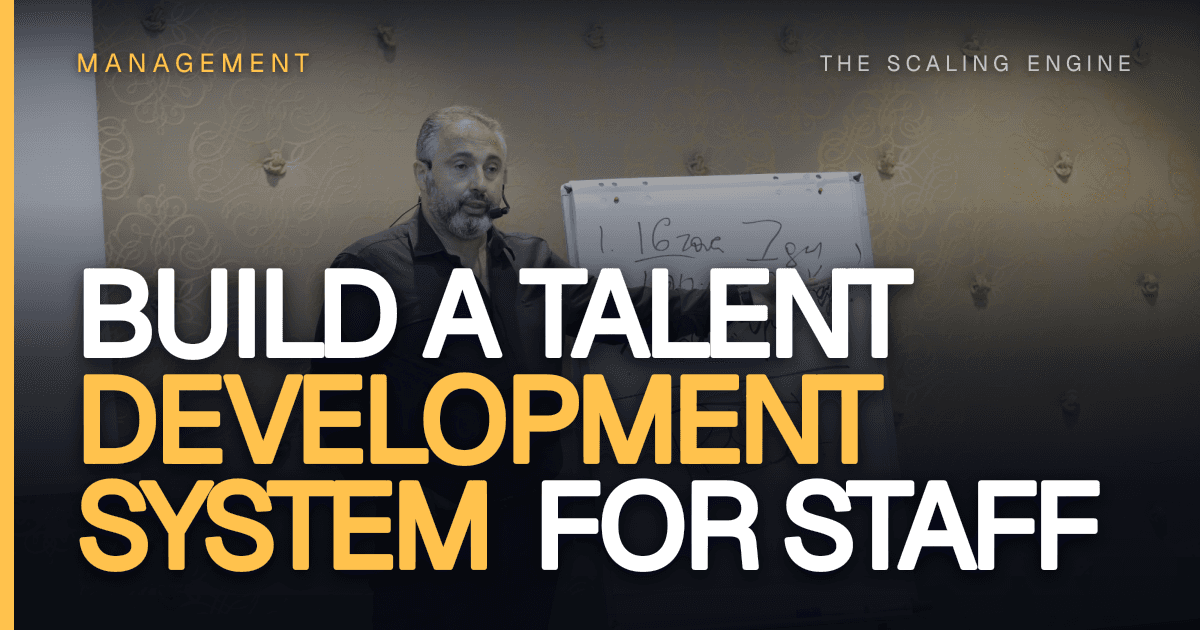
It is a structured way of rating every employee's performance on a consistent scale and tracking that data over time to guide coaching and staffing decisions.
The core tool is a Performance Matrix. Every employee is tracked on a 1-5 scale, where 1 is a top performer and 5 is poor. Instead of relying on gut feeling about who is doing well, managers record a rating for each person and review it on a regular basis. This turns performance management into something that can be measured, not just felt.
Which KPIs matter most on a performance matrix?
The key KPIs are the average employee rating, the percentage of employees rated 4 or 5, and how long it takes a new hire to reach a 1 rating.
These three numbers tell an owner different things. The average rating shows the overall health of the team. The percentage rated 4 or 5 shows how much weak performance is sitting inside the business right now. The time it takes a new hire to reach a 1 rating shows how well training and onboarding are working. Tracking all three gives a fuller picture than any single metric on its own.
Results are not typical and will vary with your business, your market, your team and how much of the work you actually do. Client figures on this site come from recorded interviews and are dated. Nothing here is a guarantee of revenue, profit or growth.
What is a realistic goal for a talent development system?
A useful goal is to eliminate all 4s and 5s within six months, since this forces weak performers to either improve or move out.
This goal works because it sets a clear deadline rather than letting weak performance linger indefinitely. Over six months, a 4 or 5 rated employee either closes the gap through coaching or gets replaced. Either outcome raises the overall quality of the team. Without a deadline like this, underperformance tends to get tolerated because there is no forcing mechanism to resolve it.
How should owners assign work based on manager type?
Owners get better results by matching managers to the kind of work they are naturally suited for, rather than assigning the same tasks to everyone.
Managers generally fall into two types. Process Managers excel at routine, systematic tasks like daily reports and standard operating procedures, which makes them ideal for scaling existing operations. Project Managers thrive on one-time, high-level challenges like negotiations or new openings, and are better suited to strategic initiatives. Giving a Project Manager a steady diet of routine process work wastes their strengths, and giving a Process Manager constant one-off strategic work can leave them without the structure they need to succeed.
Why does bringing in outside oversight help talent development?
An outside auditor can surface problems managers have stopped noticing and push for written, permanent fixes instead of quick patches.
One approach is hiring an overseas controller to audit locations and build a running list of what is not yet perfect. This gives an unbiased outside view of problems and frees up founder time from day-to-day oversight. The key is holding managers accountable for creating written, permanent solutions to problems, rather than letting them apply a quick temporary fix and move on. That same kind of controller can also support financial work, such as calculating food costs and identifying waste, which ties staff performance back to the numbers on the P&L.
Owners who want to see how this plays out in practice can look at the operator interviews on case studies, where staffing and systems changes show up alongside the financial results. For a related look at what has to be running before a location even opens, see which systems must be running before a new restaurant location opens.
Owners who want a built system rather than building one from scratch from these principles can apply to the Founders Board, which includes a licence to the Scaling Engine OS, or apply directly to discuss fit.