
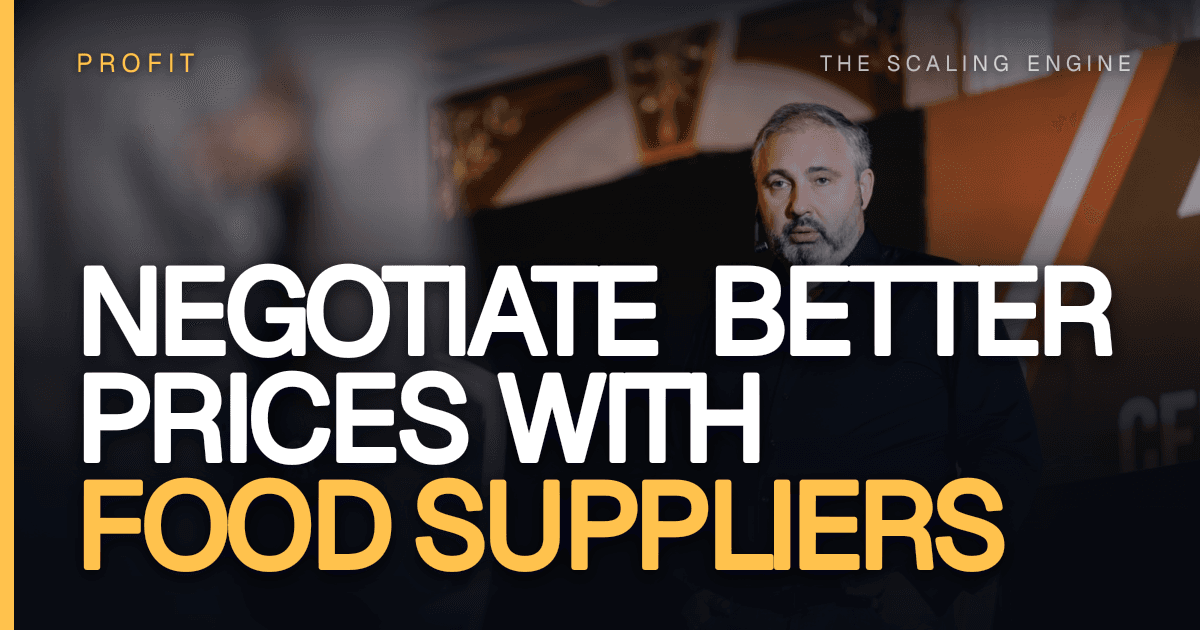
Most restaurant owners treat their food suppliers the way they treat the electric company: the price is the price, and asking for anything different feels pointless. That assumption is expensive. Suppliers set prices based on what they think a customer will accept, not on some fixed market floor, and an owner who shows up with real purchasing data can usually move that number.
What Data Do You Need Before Negotiating With a Supplier?
A restaurant needs its top 5 ingredients ranked by annual spend, recent price trends, and at least one competitive bid from another supplier before sitting down to negotiate.
Walking into a conversation and asking for a better price is not leverage. Walking in with 90 days of invoices, a ranked list of the ingredients that drive the most spend, and a written quote from an alternative supplier changes the dynamic entirely. The supplier is no longer guessing whether the owner is serious about shopping around. They can see it on paper.
- The top 5 ingredients by annual spend, these are the biggest bargaining chips
- Price trends on those items over the last several months
- Competitive bids for the same product, same quality, same delivery frequency
- Payment reliability, since paying on time is worth something to a supplier
- Growth trajectory, because a supplier values an account that is getting bigger, not smaller
How Much Money Can Better Supplier Pricing Actually Save?
On a restaurant with $450,000 in annual food purchases, a 5% reduction on the top 5 ingredients saves between $5,625 and $11,250 a year with no additional revenue required.
That is pure margin. No extra covers, no extra labor hours, no marketing spend. It is money that exists the moment the supplier agrees to a lower price on products the restaurant is already buying every week.
One member applied this to prime rib, a single item running over $12,500 a month, or $150,000 annualized. Food cost on that item had crept from 28% to 32%, and the supplier rep blamed the market. The owner pulled 90 days of invoices, got quotes from two alternative suppliers, and found the same USDA grade available for 12% less elsewhere. A single meeting with one page of data, volume, annual spend, and the competitive quote, got the existing supplier to match the price on the spot and lock it for six months. That one conversation saved $18,000 a year on one item. Repeating the process across the top 10 items cut over $47,000 from annual COGS.
What Should a Supplier Negotiation Conversation Sound Like?
An effective negotiation leads with specific numbers and a competing quote, not a general request for a discount.
Compare the two approaches. "Can you give me a better price?" gives the supplier nothing to respond to. "I am spending $8,400 a month with you on chicken at $3.20 per pound, and I have a quote for $2.85 per pound, can we discuss?" gives the supplier a specific number to react to and a reason to act before the account leaves. That second version is a business conversation, not a complaint.
Price is not the only thing on the table. Owners can also negotiate volume discounts in exchange for committing to a minimum monthly order, payment terms such as net 30 instead of net 15 or an early-pay discount, delivery frequency that lowers shipping costs, and value-adds like recipe support or menu consultation.
Results are not typical and will vary with your business, your market, your team and how much of the work you actually do. Client figures on this site come from recorded interviews and are dated. Nothing here is a guarantee of revenue, profit or growth.
What Is the Dual Supplier System?
The Dual Supplier System means keeping two active suppliers for every major spend category, splitting volume between them, so each one knows it can lose share if its pricing drifts.
One Founders Board member running 5+ locations described maintaining active accounts with two suppliers for every major category, including proteins, produce, and beverages, and splitting volume roughly 60/40 between them. Every quarter he requests updated pricing from both. Neither supplier knows exactly what the other is charging, but both know they are not the sole provider for the account. That ongoing pressure, without any aggressive negotiating, is what he estimates saves him 8-12% annually on his top 10 spend categories compared to relying on a single supplier.
“Maintain relationships with two competing suppliers for every major category. Get quarterly pricing from both. Use competitive pressure to keep costs down. Never reveal what the other supplier is charging. Let them compete for your volume.”
What Mistakes Ruin Supplier Negotiations?
The two most common mistakes are negotiating without data and switching suppliers for price alone without weighing reliability and quality.
Negotiating without data means showing up with a general request instead of a specific number and a competing quote, which gives the supplier nothing concrete to respond to. Switching for price alone ignores the rest of the relationship: reliability, delivery consistency, product quality, and responsiveness. Saving a few percentage points on an ingredient but getting inconsistent quality or late deliveries often costs more in waste and customer complaints than the discount is worth.
A third mistake is only negotiating when angry, waiting for a price increase before starting the conversation. The better approach is proactive and calm: negotiate when the relationship is good, because that is when there is the most goodwill on both sides.
How Often Should You Renegotiate With Suppliers?
Top ingredient pricing should be reviewed every quarter, since commodity prices move and a competitive price today may not stay competitive for long.
Commodity prices shift. A supplier that offered the market rate six months ago may no longer be the cheapest option now. Setting a recurring quarterly review of the top ingredients, with fresh competitive bids where needed, keeps pricing honest without requiring a confrontation every time.
This kind of structured purchasing review is one piece of the operating system Founders Board members get a license to run across their locations. For a broader look at how owners build a restaurant that runs on systems rather than constant personal involvement, see the restaurant that runs without you. For examples of owners who have applied similar discipline to their numbers, see the case studies.